January 28, 2026
Design Tips & Trends / Home Staging Design / Home Staging Insights / Interior Design
Quiet Luxury Design Psychology: The Silent Power of Understated Elegance
Quiet luxury design psychology is not a trend to me; it’s a behavioral truth. The highest-caliber clients don’t want their home to announce them. They want it to confirm them. And there’s a difference between a space that performs for attention and a space that holds authority without needing permission.
When the market is noisy, the rarest signal is restraint. It reads as confidence. It reads as control. In a premium listing, that signal can be the difference between a buyer admiring the house and a buyer trusting it.
Quiet luxury isn’t sterile minimalism, and it isn’t “beige as an aesthetic.” It’s the disciplined curation of materials, proportion, and sensory calm so the property feels inevitable. Not styled. Not explained. Simply right.
Why luxury is quieter now (and why that matters in real estate)
The cultural shift is easy to spot: logos have softened, social signaling has become more discreet, and people with real options are increasingly allergic to anything that feels performative. That isn’t just fashion. It’s psychological.
In my work, I see a parallel move in homebuying behavior at the high end. Buyers are not looking for spectacle. They’re looking for relief. They want privacy, clarity, and spaces that lower cognitive load after high-output days.
Industry research consistently points to the resilience of “timeless” value in premium categories, especially when status becomes less overt and more coded. The luxury sector has been tracking this recalibration for years, not as a vibe but as a market dynamic. Even a quick scan of what
Bain writes about luxury makes it clear: discretion is no longer niche; it’s strategic.
The psychology behind understated elegance
Here’s the part most people skip: quiet luxury works because of how the brain processes safety, status, and complexity. It’s not about “less.” It’s about the right kind of more.
Quiet luxury design psychology starts with cognitive ease
Buyers don’t tour a home like they tour a museum. They’re scanning for friction. Too many objects, too many contrasts, too many “statements,” and their nervous system goes into evaluation mode. They stay in their heads.
Understated elegance reduces decision fatigue. It creates a clean runway for the buyer to imagine themselves inside the space without having to fight the designer’s personality first. This is one of the most commercially useful principles in quiet luxury design psychology: the home becomes the buyer’s future, not the seller’s story.
Status signaling is most powerful when it’s coded
True affluence doesn’t need volume. It needs accuracy. The grain of walnut, the weight of a solid door, the softness of a plaster wall, the alignment of millwork reveals. These are cues that certain buyers recognize immediately because they’ve lived with quality.
There’s also a social psychology layer: coded signals reduce the risk of looking like you’re trying. In premium circles, trying too hard is the only real faux pas.
Restraint builds trust
In a luxury transaction, trust is a design metric. A home that feels edited, balanced, and coherent suggests that the property has been cared for with discernment. The buyer starts assuming competence behind the scenes: maintenance, systems, stewardship.
That assumption matters because luxury buyers are not only buying a home. They’re buying the experience of ownership.
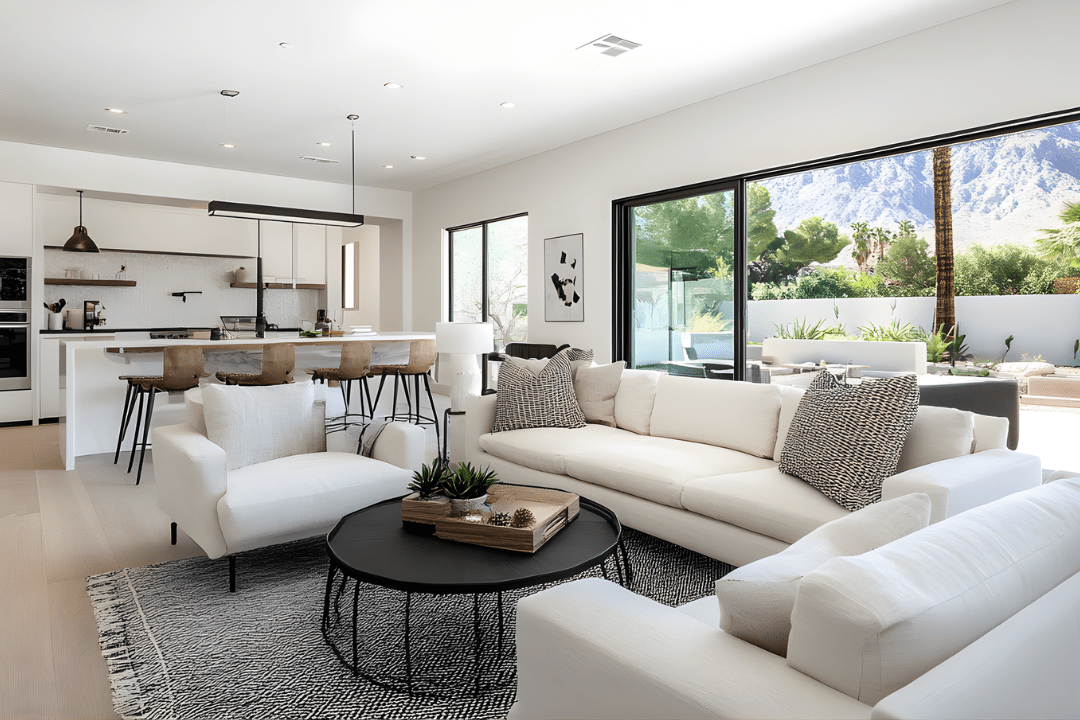
What quiet luxury looks like in a listing (without becoming bland)
The most common mistake I see is confusing restraint with absence. Quiet luxury is not empty. It’s intentional density.
In practice, that means the room has fewer items, but each item does more work. Texture replaces pattern. Proportion replaces ornament. Lighting replaces shine. If I use contrast, it’s structural, not decorative.
A few principles I return to:
- Material honesty: real stone reads differently than imitation, even in photos.
- Low-contrast harmony: tonal palettes create visual rest, especially on camera.
- Negative space as a feature: space around an object signals confidence.
- Quiet craftsmanship: tailored upholstery, clean seams, and correct scale communicate value without shouting.
None of this is about austerity. It’s about removing everything that competes with the architecture.
A real listing moment: when the “wow” factor got in the way
Last year, we were brought into a high-end listing that had been styled to impress: glossy accent walls, sculptural furniture that photographed loudly, and a dining room vignette that looked like a set. The problem was subtle but fatal. Every room was asking for applause.
Showings were steady, but momentum was flat. Feedback kept repeating the same coded phrases: “beautiful, but…” “amazing finishes, but it feels staged.” Translation: the home didn’t feel livable at that price point, and the buyer couldn’t locate themselves inside it.
We stripped the performance. We softened the lighting temperature. We replaced reflective surfaces with matte, layered textiles. We kept the architecture primary and let the furnishings become the supporting cast. In the primary suite, we reduced the decor count by more than half and introduced one strong tactile note: a textured wool rug that made the room feel grounded.
Within two weekends, the showing-to-second-visit ratio shifted noticeably. The agent called it “calmer energy.” I call it the buyer’s nervous system finally agreeing with the price.
The business case: quiet luxury as a marketing advantage
Luxury agents and developers don’t need another aesthetic lecture. You need an advantage that translates into buyer behavior and sales velocity.
One KPI I track with teams is
qualified follow-up intensity: the number of serious post-showing actions within 72 hours (second showings, disclosure requests, proof-of-funds readiness, private appointments). Quiet luxury staging tends to increase this because it reduces the buyer’s internal objections. They feel composed in the home, so their decision-making becomes cleaner.
There’s also a content advantage. Understated rooms photograph with a certain authority. Editorial platforms respond to coherence and restraint because it reads as timeless rather than trendy. If you want press pickup, you don’t give the internet more noise; you give it clarity. You can see how design media frames this sensibility in places like
Architectural Digest, where the strongest spaces don’t rely on gimmicks to hold attention.
And from a market perspective, prestige buyers are not only buying square footage. They are buying a self-image. The home has to align with who they believe they are, or who they are becoming. That’s why quiet luxury isn’t merely “pretty.” It’s identity-compatible.
How to deploy quiet luxury without erasing personality
Developers and agents sometimes hear “quiet” and worry it will flatten the property. The opposite is true, if you know where to put the emphasis.
Quiet luxury doesn’t remove personality. It relocates it. Instead of loud decor, personality lives in:
- Architectural highlights: sightlines, ceiling detail, door hardware, window scale.
- Material composition: warm woods against cool stones, linen against lacquer.
- Intentional scarcity: one meaningful artwork, one exceptional chair, one impeccable bouquet.
This is where staging becomes strategy, not styling. You’re not filling rooms. You’re curating perception.
For agents, the language matters too. Don’t sell “minimal.” Sell “composed.” Don’t sell “neutral.” Sell “quiet confidence.” The buyer is not paying for emptiness. They’re paying for a standard.
What high-net-worth clients are really seeking
Discretion is not a preference; it’s a lifestyle requirement. Many premium buyers live with visibility, pressure, or public consequence. Their home needs to counterbalance that. Quiet luxury design psychology aligns with their internal need for containment: fewer visual demands, more sensory stability, more control over what enters their space.
Understated elegance also gives them freedom. When the home isn’t locked into a trend, it can hold different seasons of life without being reinvented. That continuity is its own form of wealth.
For a developer, this means the most valuable “upgrade” is often not a flashier feature, but a more refined baseline: better lighting plans, calmer material palettes, stronger joinery. For an agent, it means the strongest marketing is often the most edited. If everything is special, nothing is.
Quiet luxury is a leadership stance
I’ve always thought of space as a form of communication. The best spaces don’t plead to be seen. They are legible. They make people feel more like themselves, not more like spectators.
Quiet luxury is the aesthetic equivalent of emotional control. It signals discernment, self-trust, and standards that don’t change with the room. In a market full of noise, that steadiness becomes a differentiator.
For teams who want to translate this into real outcomes, the path is simple: treat staging as behavioral design. Reduce cognitive friction. Use materials that read as real. Let the architecture lead. And edit until the home feels inevitable.
Explore Elite
Samantha Senia is the
founder and principal of Elite Home Staging and
Elite Maison, where she leads with an eye for emotional precision, spatial psychology, and aesthetic intelligence. Her work reshapes how space communicates identity, influence, and intention in interior design for luxury real estate.